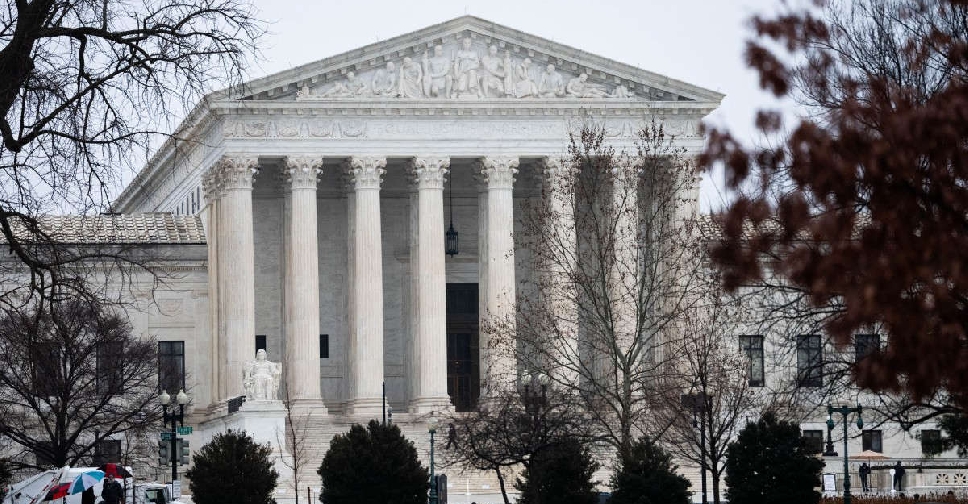
The US Supreme Court struck down Donald Trump's sweeping tariffs that he pursued under a law meant for use in national emergencies, handing a stinging defeat to the Republican president in a landmark opinion on Friday with major implications for the global economy.
The justices, in a 6-3 ruling authored by conservative Chief Justice John Roberts, upheld a lower court's decision that Trump's use of this 1977 law exceeded his authority.
The justices ruled that the law at issue - the International Emergency Economic Powers Act, or IEEPA - did not grant Trump the power he claimed to impose tariffs.
"Our task today is to decide only whether the power to "regulate ... importation," as granted to the president in IEEPA, embraces the power to impose tariffs. It does not," Roberts wrote in the ruling, quoting the statute's text that Trump claimed had justified his sweeping tariffs.
The White House had no immediate comment on the ruling. Democrats and various industry groups hailed the ruling.
Many business groups expressed concern that the decision will lead to months of additional uncertainty as the administration pursues new tariffs through other legal authorities.
The ruling sent US stock indexes, long buffetted by Trump's unpredictable moves on tariffs, up by the most in more than two weeks and weakened the dollar. Treasury yields edged higher.
Justice Brett Kavanaugh, writing a dissent joined by fellow conservatives Clarence Thomas and Samuel Alito, wrote that the ruling did not necessarily foreclose Trump "from imposing most if not all of these same sorts of tariffs under other statutory authorities," adding that "the court's decision is not likely to greatly restrict presidential tariff authority going forward."
Part of the Supreme Court's majority also declared that such an interpretation would intrude on the powers of Congress and violate a legal principle called the "major questions" doctrine.
The conservative doctrine requires actions by the government's executive branch of "vast economic and political significance" to be clearly authorized by Congress.
The court used the doctrine to stymie some of Democratic former President Joe Biden's key executive actions.
Roberts, citing a prior Supreme Court ruling, wrote that "the president must 'point to clear congressional authorization' to justify his extraordinary assertion of the power to impose tariffs," adding: "He cannot."
Roberts wrote that if Congress had intended IEEPA to bestow on the president "the distinct and extraordinary power to impose tariffs, it would have done so expressly - as it consistently has in other tariff statutes."
Trump has leveraged tariffs - taxes on imported goods - as a key economic and foreign policy tool.
They have been central to a global trade war that Trump initiated after he began his second term as president, one that has alienated trading partners, affected financial markets and caused global economic uncertainty.
The Supreme Court reached its conclusion in a legal challenge by businesses affected by the tariffs and 12 US states, most of them Democratic-governed, against Trump's unprecedented use of this law to unilaterally impose the import taxes.
Joining Roberts in the majority were conservative Justices Neil Gorsuch and Amy Coney Barrett, both of whom Trump appointed during his first term in office, along with the three liberal justices, Sonia Sotomayor, Elena Kagan and Ketanji Brown Jackson.
The liberal justices did not join the part of the opinion invoking the major questions doctrine.
The Supreme Court, which has a 6-3 conservative majority, previously had backed Trump in a series of other decisions issued on an emergency basis since he returned to the presidency in January 2025 after his policies were impeded by lower courts.
Trump's tariffs were forecast to generate over the next decade trillions of dollars in revenue for the United States, which possesses the world's largest economy.
His administration has not provided tariffs collection data since December 14. But Penn-Wharton Budget Model economists estimated on Friday that the amount collected in Trump's tariffs based on IEEPA stood at more than $175 billion.
And that amount likely would need to be refunded with a Supreme Court ruling against the IEEPA-based tariffs.
POWERS OF CONGRESS
The US Constitution grants Congress, not the president, the authority to issue taxes and tariffs. But Trump instead turned to a statutory authority by invoking IEEPA to impose the tariffs on nearly every US trading partner without the approval of Congress.
Trump has imposed some additional tariffs under other laws that are not at issue in this case. Based on government data from October to mid-December, those represent about a third of the revenue from Trump-imposed tariffs.
IEEPA lets a president regulate commerce in a national emergency. Trump became the first president to use IEEPA to impose tariffs, one of the many ways he has aggressively pushed the boundaries of executive authority since he returned to office in areas as varied as his crackdown on immigration, the firing of federal agency officials, domestic military deployments and military operations overseas.
Kavanaugh, who also was appointed by Trump during his first term as president, in a written dissent said that IEEPA's text, as well as history and prior Supreme Court rulings supported the Trump administration's position.
"Like quotas and embargoes, tariffs are a traditional and common tool to regulate importation," wrote Kavanaugh, whose dissenting opinion was joined by Thomas and Alito.
"The tariffs at issue here may or may not be wise policy," Kavanaugh added. "But as a matter of text, history, and precedent, they are clearly lawful. I respectfully dissent."
Kavanaugh, in his dissent, expressed concern that the ruling would likely generate "serious practical consequences in the near term," including issues related to refunds and the role tariffs played in reaching international trade deals.
"Because IEEPA tariffs have helped facilitate trade deals worth trillions of dollars—including with foreign nations from China to the United Kingdom to Japan, the Court's decision could generate uncertainty regarding various trade agreements," Kavanaugh wrote.
"Refunds of billions of dollars would have significant consequences for the US Treasury," Kavanaugh added.
Trump described the tariffs as vital for US economic security, predicting that the country would be defenceless and ruined without them.
Trump in November told reporters that without his tariffs "the rest of the world would laugh at us because they've used tariffs against us for years and took advantage of us." Trump said the United States was abused by other countries including China, the second-largest economy.
Candace Laing, president and CEO of the Canadian Chamber of Commerce, said the decision was a legal ruling, not a reset of US trade policy.
"Canada should prepare for new, blunter mechanisms to be used to reassert trade pressure, potentially with broader and more disruptive effects," Laing said in a statement.
After the Supreme Court heard arguments in the case in November, Trump said he would consider alternatives if it ruled against him on tariffs, telling reporters that "we'll have to develop a 'game two' plan."
Treasury Secretary Scott Bessent and other administration officials said the United States would invoke other legal justifications to retain as many of Trump's tariffs as possible.
Among others, these include a statutory provision that permits tariffs on imported goods that threaten US national security and another that allows retaliatory actions including tariffs against trading partners that the Office of the US Trade Representative determines have used unfair trade practices against American exporters.
None of these alternatives offered the flexibility and blunt-force dynamics that IEEPA provided Trump, and may not be able to replicate the full scope of his tariffs in a timely fashion.
Senate Democratic Leader Chuck Schumer called the decision a "victory for the wallets of every American consumer," adding: Trump's illegal tariff tax just collapsed. He tried to govern by decree and stuck families with the bill. Enough chaos. End the trade war."
Democratic Senator Elizabeth Warren said the ruling left many questions unanswered.
"The Court has struck down these destructive tariffs, but there is no legal mechanism for consumers and many small businesses to recoup the money they have already paid. Instead, giant corporations with their armies of lawyers and lobbyists can sue for tariff refunds, then just pocket the money for themselves," Warren said.

 Police search royal mansion as investigation into king's brother goes on
 7 bodies found after Chinese tour bus plunges into frozen lake in Russia's Siberia
 ASOS co-founder Quentin Griffiths dies in Thailand after balcony fall
 Former Philippines president Duterte will not attend ICC pre-trial hearings
 South Korea's ex-President Yoon apologises after life sentence over martial law