
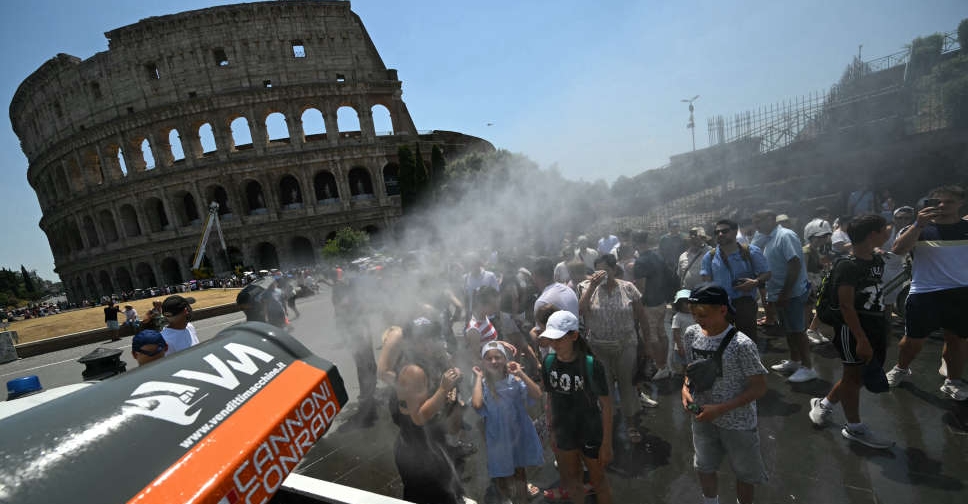
Italy and the Balkans felt the impact on Monday of the record-breaking heatwave that has caused hundreds of excess deaths and disrupted daily life across the continent for more than a week, with growing concerns over the spread of wildfires.
There was also a warning that the heat was likely to build again from the start of next week in countries such as France and Germany that bore the brunt over the past few days.
In Italy, 22 cities from Bolzano in the north to Palermo on the southern island of Sicily were covered by a red heat warning.
Pilgrims at the Vatican used fans to cool themselves and sheltered under umbrellas for shade as Pope Leo delivered his Angelus message from a balcony to the crowd below on the Feast of Saints Peter and Paul, a holiday in the city of Rome.
In Croatia, the weather service issued a red alert on Monday for regions including the capital Zagreb and the tourist destinations of Split and Dubrovnik.
Dozens of firefighters, assisted by four aircraft, battled a wildfire burning pine forests on the tourist island of Vis in the Adriatic Sea, some 55 km southwest of Split.
In neighbouring Serbia, the State Hydrometeorological Service (RHMZ) has warned temperatures would reach 39 degrees Celsius on Monday.
Further south, Albania contained a wildfire that has consumed many hectares of bushes and olive trees near the southern village of Klos over the weekend.
Scientists have said the heatwave, which began on June 20, was the worst recorded in Europe, and the blistering conditions have disrupted power generation, damaged infrastructure and overwhelmed healthcare systems.
France has reported 1,000 excess deaths during the heatwave. The French public health agency said most of the heat-related fatalities involved older people and warned the number was expected to rise.
The heatwave would have been "virtually impossible" without human-caused climate change, which has made this week's soaring night-time temperatures 100 times more likely than they would have been just two decades ago, according to scientists.
HEAT TO RISE AGAIN FURTHER WEST
Luca Mercalli, the president of Italy's Meteorological Society, said temperatures were set to soar again from July 5-6.
"The areas affected look broadly the same as in the first wave, including France, Spain, Germany, Italy, Switzerland and to some extent Britain," he told Reuters. "With the extreme heat the risk of forest fires increases, but we are also seeing a lot of rainstorms, which obviously mitigates that risk," he added, noting that storms were very localised so rainfall amounts could vary greatly.
Further tragedies related to the heat were reported at the weekend.
Two boys aged 8 and 10 from Bulgaria were found dead in a hot car in Cyprus on Sunday afternoon, police said. Cyprus is currently experiencing temperatures of around 38 C, which is not classified as a heatwave on the east Mediterranean island for the time of year.
Two cyclists, a 30-year-old and a 71-year-old, died while taking part in an event in the Poland Bike Marathon series in Marki near Warsaw on Sunday.
Temperatures in Poland reached a new record high on Sunday at 40.5 C.

 Iran and US agree to halt attacks, talks scheduled in Doha on Tuesday
 Aftershock hits Caracas as rescue efforts enter critical hours in Venezuela
 UK's prime minister-in-waiting vows to rip up politics as usual
 Pakistan forces kill 29 militants in border operation, Kabul says dozens of civilians dead
 Putin rejects Ukraine proposal to limit long-range strikes