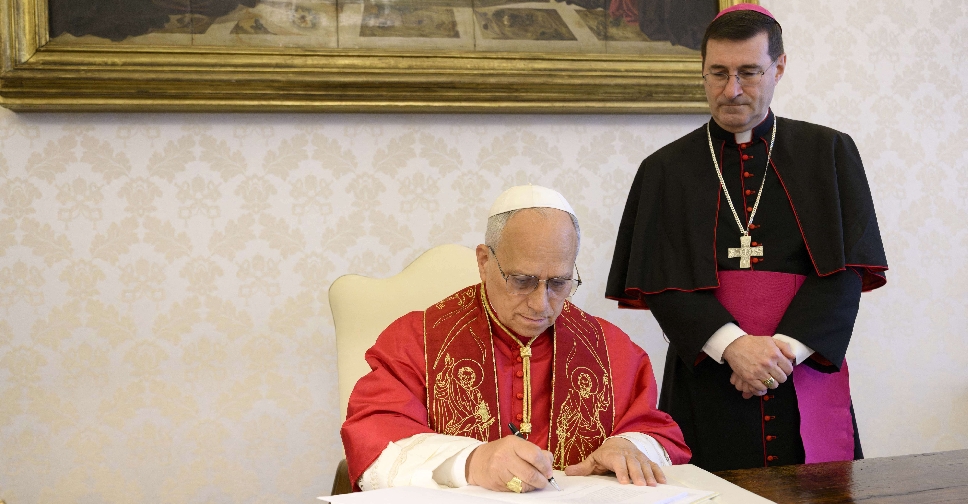
Pope Leo on Monday issued the clearest apology yet from a pontiff for the Catholic Church's role in slavery, acknowledging both its delay in condemning the practice and its historic involvement in legitimising it.
In a key passage of his first papal encyclical, Leo said the Church had taken centuries to fully recognise "the scourge of slavery" as incompatible with human dignity, calling the legacy "a wound in Christian memory."
"For this, in the name of the Church, I sincerely ask for pardon," he wrote in the wide-ranging manifesto, expressing "deep sorrow" for the suffering endured by enslaved people.
Leo acknowledged that Church authorities had, at times, responded to rulers by regulating and legitimising forms of subjugation, including the enslavement of non-Christians.
He also acknowledged that before that time, in the Middle Ages, ecclesiastical institutions had their own slaves.
He said the Church only reached a "formal, absolute and universal condemnation" of slavery in the 19th century, under Pope Leo XIII, after what the current pope described as a long period of inconsistency in teaching and practice.
The remarks mark the most explicit papal admission to date of institutional responsibility, going beyond earlier statements by previous popes that focused on the actions of individual Christians rather than the Vatican itself.
Pope John Paul II, during a 1985 visit to Africa, asked forgiveness from Africans for the suffering caused by "men belonging to Christian nations" in the slave trade.
Leo's predecessor Francis condemned the plight of modern-day slaves and formally repudiated papal documents from the 15th century which were used by colonial powers to give legitimacy to their actions, which included slavery.
But such statements stopped short of directly addressing the role of the papacy, instead framing responsibility in broader terms tied to Christians or historical circumstances.
Leo's intervention was made in his debut encyclical, "Magnifica Humanitas" (Magnificent Humanity), which addresses the ethical challenges of artificial intelligence and warns of new forms of exploitation linked to the global economy.
Genealogical research published after Leo's election last year showed that history's first US-born pope had a diverse ancestry that included both enslaved people and slaveholders.

 Trump says US and Tehran having 'good talks'
 Israel to allow international force into Gaza, Israeli official says
 Saudi Arabia reaffirms right to defend its security against drone attacks
 UK's Burnham welcomes Zelenskyy as first foreign visitor
 Philippines' Marcos puts anti-graft campaign at centre of address to Congress