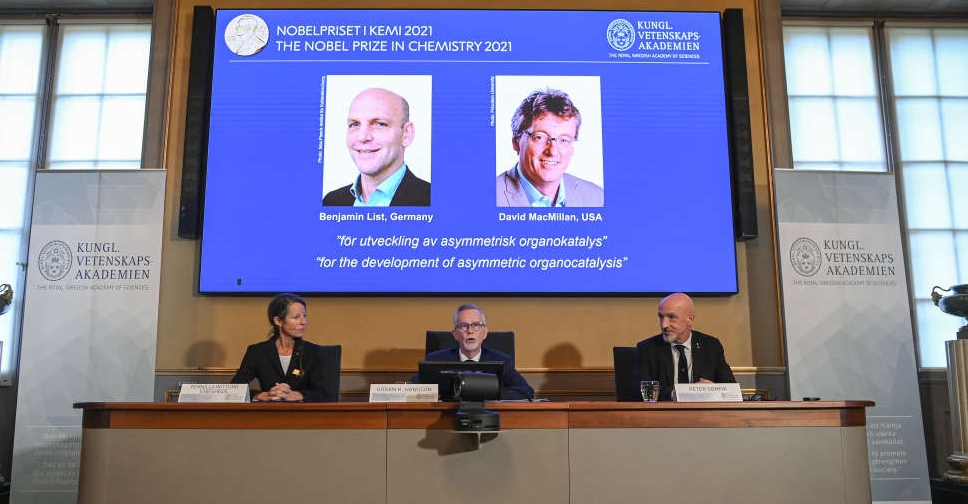
German Benjamin List and Scottish-born David MacMillan won the 2021 Nobel Prize in Chemistry for their development of asymmetric organocatalysis, a "new and ingenious tool for molecule building".
"Organic catalysts can be used to drive multitudes of chemical reactions," the Royal Swedish Academy of Sciences said in a statement. "Using these reactions, researchers can now more efficiently construct anything from new pharmaceuticals to molecules that can capture light in solar cells."
It said these catalysts were both environmentally friendly and cheap to produce.
The more than century-old prize is awarded by the Royal Swedish Academy of Sciences and is worth 10 million Swedish crowns ($1.14 million).
The Nobel prizes, for achievements in science, literature and peace, were created and funded in the will of Swedish dynamite inventor and businessman Alfred Nobel. They have been awarded since 1901, with the economics prize first handed out in 1969.
The chemistry award is the third of this year's crop of Nobel prizes and follows the prizes for medicine or physiology, and physics, announced earlier this week.
Previous winners of the Chemistry prize include Marie Curie and Fredrick Sanger, who won twice.
Seven women have won, including last year's laureates Emmanuelle Charpentier and Jennifer Doudna who were awarded the prize for creating genetic 'scissors' that can edit DNA.


 Several people detained in India's Gen Z-led protests against voter roll changes
 Trump shares Republican senator's phone number in feud over time switch
 Saudi Arabia says shrapnel from intercepted ballistic missile in Asir injures one
 Israeli strike kills five in Gaza, health officials say
 Nine injured in Australia as car crashes into crowd north of Sydney