

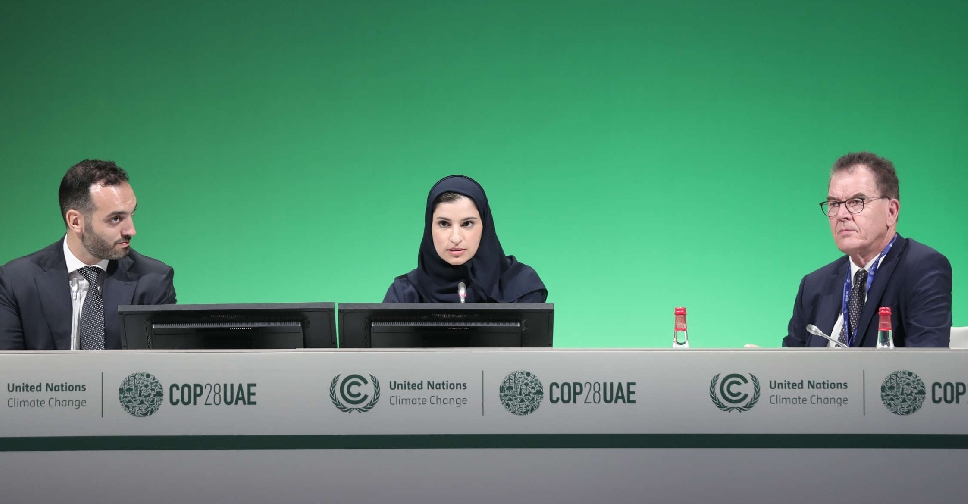
The UAE has launched its Industrial Decarbonisation Roadmap with the aim of reducing industrial carbon emissions by 2.9 gigatonnes until 2050.
The initiative, which was announced on the sidelines of COP28, focuses on manufacturing and hard-to-abate sectors, including cement, iron, steel and aluminium.
The Ministry of Industry and Advanced Technology built the roadmap alongside strategic partners in the government and private sectors.
Sarah bint Yousef Al Amiri, Minister of State for Public Education and Advanced Technology said: "The roadmap focuses on the development and adoption of advanced technology to drive a phased carbon reduction of 93 per cent by 2050 across the national industrial sector."
"It includes a set of pathways around monitoring and addressing challenges as well as developing and adopting the latest technologies. It also focuses on promoting the competitiveness and development of the national industrial sector," she added.
Three main phases
The roadmap comprises three phases. The first aims to reduce emissions by 5 per cent by 2030, while the second targets a 63 per cent reduction by 2040. Through the scaling and decreasing cost of technologies, emissions reduction is expected to reach 93 per cent by 2050.
The ministry and its partners have examined and evaluated the feasibility of more than 50 advanced technologies and innovative solutions.
These include clean electricity, carbon capture, utilisation and storage (CCUS), manufacturing efficiency, alternative fuels, recycling, clinker substitutes, and hydrogen.
Within the roadmap, there are separate decarbonisation timelines for different hard-to-abate sectors, including iron, steel, aluminium, cement, and petrochemicals.
Various technologies are mapped against the different industries, based on how much each solution could contribute to decarbonisation in that particular sector.
The roadmap indicates that CCUS, clean electricity and efficiency enhancements alone could be responsible for a 70 per cent carbon reduction by 2050, with the remaining 23 per cent made up by other solutions.
The action plan set out in the roadmap will cut 90 million tonnes of carbon dioxide annually. Clean electricity alone could contribute to 41 per cent of the targeted reduction by 2050.


 All Abu Dhabi restaurants, eateries to introduce calorie-labelled menus
 Dubai approves AED56.5 billion in contracts for Al Maktoum International Airport
 Ajman adopts safety framework to tackle bullying, abuse in schools
 UAE foils attempt to smuggle over 24kg of drugs concealed in truck's chassis
 H.H. Sheikh Mohammed directs task force to 'accelerate work' on AI assistant Mira
 DOERS Summit Dubai puts AI, innovation and investment in focus
 UAE education ministry dismisses social media video of student action as misleading
 Dubai boosts marine tourism with winter cruises, NYE experiences
 Death toll rises to 13 in Ras Al Khaimah bus-truck collision
 UAE strongly condemns Houthi targeting of Saudi Arabia's Riyadh
 UAE welcomes Kenya, DRC agreement to restore diplomatic ties
 flydubai flight from Krakow diverted due to technical issue
 UAE maintains strong position in Global Knowledge Index
 flydubai says 'working with relevant authorities' to resume Tel Aviv operations
 H.H. Sheikh Mohammed opens new FNC session
 UAE assumes presidency of Federation of Arab News Agencies
 UAE pledges $30,000 to developing countries
 Sheikh Abdullah meets global counterparts
 UN water conferences to be held every 3 years under UAE-Senegal resolution
 UAE President discusses national priorities with Fujairah Ruler