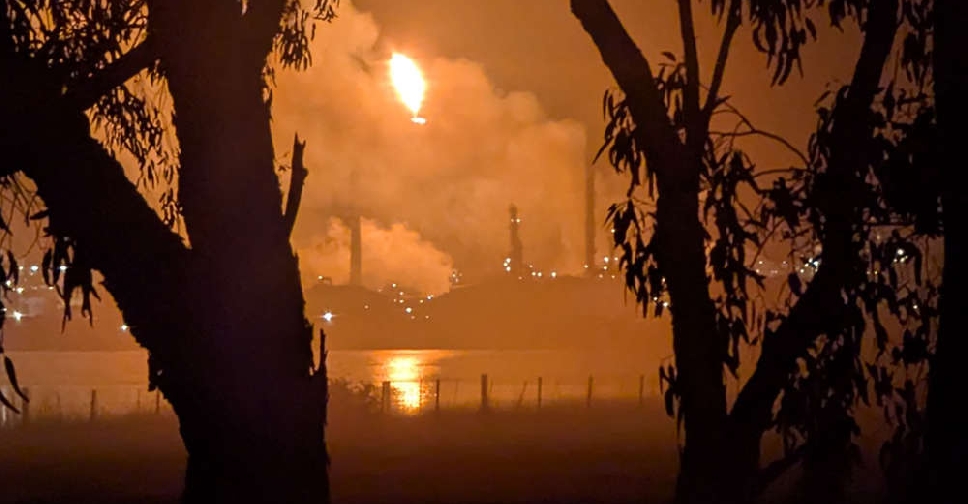
A fire at the largest of Australia's two oil refineries has hit petrol production, company and government officials said on Thursday, just as the nation faces pressure to shore up fuel security with the Iran war disrupting global supply.
State fire authorities said the blaze, which broke out at a 120,000 barrels-per day refinery run by Viva Energy VEA.AX on Wednesday night, had been brought "under control" at noon (0200 GMT) on Thursday.
The fire came at a bad time for Australia as it depends on imports for 80% of its fuel needs and has been racing to replace supply disrupted by the Middle East conflict, which has driven up energy prices worldwide.
"This is not a positive development, but obviously there's a long way to go in terms of working out just what the impact is," Energy Minister Chris Bowen told Channel Nine.
Viva Energy's refinery supplies over half of the fuel in Australia's second most populous state, Victoria, and a tenth of the country's total demand.
The company said it expects output of petrol and aviation gasoline will be affected, but it will meet fuel demand through imports.
The plant is still producing jet fuel and diesel but at reduced levels for safety reasons, Bowen said.
“I would expect we'd see a price hike depending on the scale of the damage, and secondly, it reinforces the challenges we have in terms of sovereign and resilient capabilities here,” Australian Strategic Policy Institute analyst John Coyne said.
The incident comes as Prime Minister Anthony Albanese visits Kuala Lumpur on Thursday to discuss securing fuel supplies with his Malaysian counterpart, Anwar Ibrahim, following similar trips to Singapore and Brunei.
Malaysia and Brunei, which produce crude oil and refined products, could increase production but only to a certain degree, Coyne said.
No injuries have been reported from the fire at the refinery located about an hour's drive from Melbourne. The cause of the blaze and the extent of the damage was not immediately clear.
PUMP PRICES LIKELY TO RISE
In the nearly seven weeks since the war began, supply fears have stoked panic buying, doubling demand for fuel in some areas, despite assurances from the government the market is well supplied.
Last month, Albanese announced temporary relief measures including halving the fuel excise and suspending the heavy road user charge for three months to help households cope with a surge in costs driven by the Iran war.
"It's going to be a very bumpy and expensive few months,” said Tennant Reed, climate change and energy director at Australian Industry Group.
In March the government committed to underwriting a portion of fuel purchases by refiners and suppliers.
"We'll continue to work with the company to do what we can to make sure that anything that is offline is brought online as soon as possible," Albanese said at a media conference in Malaysia's administrative capital, Putrajaya.
Reed said the government could go to market to secure more supply to make up for any loss of production at Viva's plant, but it would still take weeks for the cargoes to arrive.
PRODUCTION AT MINIMUM RATES
Viva Energy CEO Scott Wyatt told reporters the primary focus was to completely put out the fire that hit operations at two units at the refinery before assessing damage and safely restoring production.
"All the other units are still operating and still in production but they are at minimum rates to maintain safety across the site," he said.
"We'll only start increasing production again once we're confident that we can do that safely."
Viva's shares were on a trading halt pending an update on the impact of the fire.

 Fire in rebel-held east Congo kills 24 schoolchildren
 Trump touts $5,000 payout if Republicans win as Vance waits in wings
 Search expands after Philippine ferry fire kills five and leaves dozens missing
 Trump says Iran war to end after US midterm elections
 At least 20 killed in cargo vessel fire at China shipyard, state media reports