

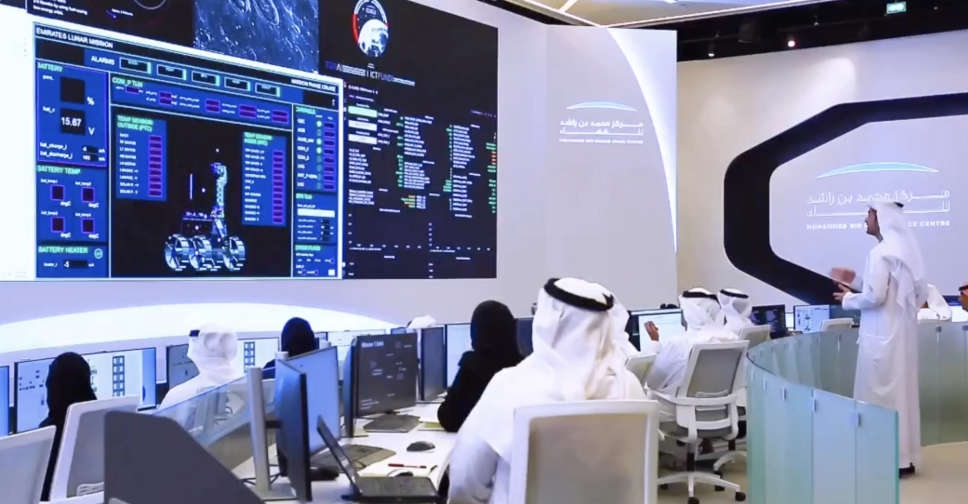
The UAE's Rashid Rover has successfully completed one month in space, travelling close to 1.34 million km.
The first Arab-built lunar rover, designed and built by a 100 per cent Emirati team of engineers, experts, and researchers, lifted off on December 11, 2022, from Cape Canaveral Space Force Station in Florida.
According to the Mohammed Bin Rashid Space Centre (MBRSC), the Emirates Lunar Mission (ELM) team has completed 220 minutes of communication with the world’s most compact rover, since its launch.
The team has completed all scheduled health assessment and maintenance checks of the rover and its onboard subsystems and instruments.
For two weeks after the launch, Rashid was powered on for 10 minutes daily, and the team on Earth is now communicating with it once every week.
During the ongoing four-month cruise phase, the team will communicate with the Rashid Rover for another 150 minutes.
The ELM team also noted that the Rashid Rover’s subsystems had been activated 17 times since launch. The subsystems were powered on for one hour the first time, followed by 10 minutes of daily activation over the subsequent two weeks.
Currently, the rover’s subsystems are being powered on once every week for 10 minutes.
.@MBRSpaceCentre: The Rashid Rover has successfully completed one month in space, travelling close to 1.34 million km. Since the launch, the Emirates Lunar Mission (ELM) team has completed 220 minutes of communication with the world’s most compact rover.https://t.co/Wf8hhUSjRU pic.twitter.com/AzB6ELLDQh
— Dubai Media Office (@DXBMediaOffice) January 13, 2023
The team is now preparing for the entry, descent, and landing (EDL) phase and surface operations. As part of the current cruise phase, the team will conduct 12 simulated mission rehearsals organised at the MBRSC ground station for surface operations before the rover’s lunar landing in end-April.
The rehearsals will allow the engineering team to prepare their programmes for execution post the lunar landing while enabling different subsystem teams to sync their work.
The following navigation stage for the HAKUTO-R Mission 1 lunar lander that holds the Rashid Rover includes planned deep space orbital control manoeuvres and successfully targeting the first lunar orbit insertion.
During its mission, the Rashid Rover will conduct numerous scientific tests on the surface of the Moon that will contribute to making qualitative developments in the fields of science, communication technologies and robotics.
The impact of these developments will extend beyond the space sector and into various vital sectors in the national and global economy.
The mission is funded by the ICT Fund of the Telecommunications and Digital Government Regulatory Authority (TDRA), which aims to support research and development in the ICT sector in the UAE.


 UAE President, King of Bahrain discuss stronger ties and regional stability
 UAE, DR Congo Presidents discuss strengthening cooperation under CEPA
 UAE leaders highlight youth's role central to nation's future
 UAE highlights flexible, skills-based education model at BRICS meeting
 Abu Dhabi Customs raises alert over fraudulent messages
 UAE President meets Lulu founder Yusuff Ali during Abu Dhabi store visit
 UAE issues special coins to mark contribution of youth in country's progress
 Sharjah Ruler approves 470 scholarships for new academic year
 UAE continues mobile health clinic operations in Gaza
 UAE expands youth empowerment efforts across key sectors
 UAE authorities seize 3.5 million non-compliant excise goods
 Gargash highlights need to end region's 'indefinite' state
 UAE pays out AED512 million under unemployment insurance scheme
 UAE expresses support for Colombia after deadly earthquake
 UAE thwarts cyberattacks targeting aviation, energy and education sectors
 UAE's post-pandemic hiring recovery among world’s strongest
 UAE Minister of State holds talks with President of Zimbabwe
 New lane on Sheikh Zayed Road to improve access to WTC intersection
 Nominations for first Dubai-it Award open August 10
 UAE convoys deliver 663 tonnes of aid to Gaza

