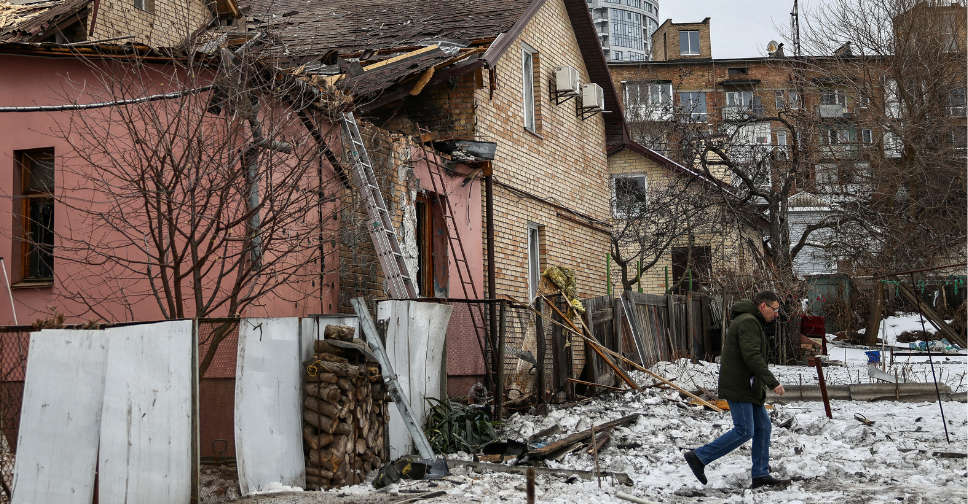
The International Monetary Fund's executive board has approved an $8.1 billion, four-year loan for Ukraine on Thursday, with $1.5 billion to be disbursed immediately to help keep the government running as its war against Russia's invasion drags into a fifth year.
The IMF said the new Extended Fund Facility arrangement for Ukraine would help anchor a $136.5 billion international support package for the war-torn country, which this week marked the fourth anniversary of Russia's full-scale invasion.
The new loan, which replaces a $15.5 billion program that was approved in 2023, will help Kyiv to maintain economic stability and keep public spending flowing, the IMF said.
Ukrainian Prime Minister Yulia Svyrydenko hailed the IMF loan as part of a broader financial framework that would cover an estimated budget shortfall of $136.5 billion over four years, including a 90 billion euro loan from the European Union.
"It is very important for us that in the fifth year of the full-scale war, against the backdrop of systematic attacks on the energy sector, Ukraine has guaranteed international financial support from partners and the resources for the stable functioning of the state," she wrote on Telegram.
The World Bank, European Union, United Nations and the Ukrainian government this week issued a new report that put the cost of rebuilding Ukraine at $588 billion over the next decade.
IMF Managing Director Kristalina Georgieva said the IMF loan would resolve Ukraine’s balance of payments problem and restore medium-term external viability, while boosting prospects for reconstruction and growth after the war ended and help to facilitate Ukraine's steps to join the European Union.
“Ukraine and its people have weathered a long and devastating war for over four years with remarkable resilience," she said in a statement, lauding work by Ukrainian authorities to maintain overall macroeconomic and financial stability, boost domestic revenues and advance some critical reforms.
She said officials were committed to "tackling longstanding bottlenecks to growth," including through continued efforts to combat corruption, address tax avoidance and evasion, reform energy markets, and strengthen financial market infrastructure.
The program would be "promptly recalibrated" in the case of successful peace negotiations, she said in a statement.
GROWTH SLOW, BUT INFLATION HALVED
Georgieva, who paid a surprise visit to Ukraine last month, said the war had taken a toll on economic and social conditions, despite efforts by authorities to stabilise the economy, contain inflation, and restructure private sector debt. The new loan aimed to deepen structural reforms, she said.
That meant growth was slowing and the economic outlook remained "subject to exceptionally high uncertainty," she said.
The IMF now projects that Ukraine's economy will grow by 1.8 per cent to 2.5 per cent in 2026, after growth of an estimated 1.8 per cent to 2.2 per cent in 2025. Inflation was expected to be around 6.1 per cent this year, half the 12.7 per cent rate recorded in 2025, the IMF said.
Ukraine's estimated financing gap of $52 billion in 2026 would be filled through disbursements under the newly approved IMF program, European Union arrangements, funds from the Group of Seven advanced economies, and bilateral support, the IMF said.
Georgieva said a large number of IMF members, including the US, Germany, Canada, Britain, and Japan, had reaffirmed their recognition of the IMF's preferred creditor status in respect to the money it owed the Fund, and agreed to "adequate financial support" to ensure Ukraine could repay its debts to the IMF. Other countries backing Ukraine were Austria, Belgium, Denmark, Estonia, Finland, France, Greece, Iceland, Ireland, Italy, Lithuania, Luxembourg, the Netherlands, Norway, Poland, Portugal, Spain, and Sweden, she said.
The Group of Creditors of Ukraine, which holds the majority of Ukraine’s official bilateral debt, also agreed to extend the current debt standstill and complete a definitive debt treatment after the resolution of the current state of "exceptionally high uncertainty," the IMF said in its statement.
Georgieva said the risks to the loan were exceptionally high and the program's success would depend on continued international support, as well as the authorities' "steadfast determination" to implement ambitious structural reforms.
A staff report noted that progress on reforms had been mixed under the previous program, with Kyiv completing some important milestones, but missing two end-December benchmarks related to public investment management and valuation standards.
Ukraine's progress on the program will be reviewed quarterly, with nine reviews planned over the next four years.

 Pakistan bombs targets in Afghan cities, minister calls it 'open war'
 Hillary Clinton tells panel she has no information on Epstein
 US, Ukraine discuss post-war reconstruction as Russia pummels grid
 Israeli fire kills three people in Gaza as truce deal staggers
 Cuban forces kill 4 exiles who attacked from Florida speedboat