
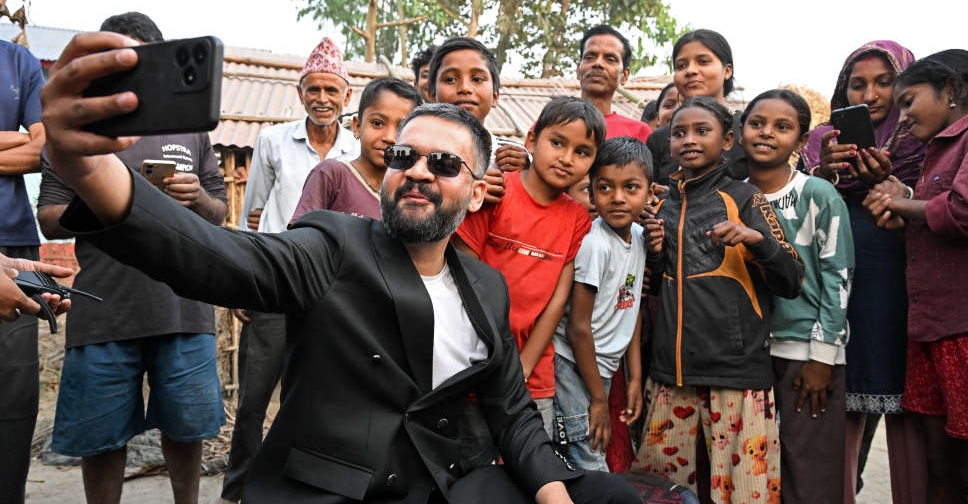
After Nepal's historic youth-led uprising last September killed 77 people and forced then Prime Minister K.P. Sharma Oli to resign, a 35-year-old rapper-turned-politician has posted a typically terse message to millions of followers on social media.
"Dear Gen Z, the resignation of your killer has come," Balendra Shah, popularly known only as Balen, wrote. "Now your generation will have to lead the country. Be prepared."
Five months on, the musician who cut his political teeth when he became the mayor of the capital Kathmandu in 2022, is dominating the race to become Nepal's next prime minister after a general election on March 5.
There are no reliable opinion polls in Nepal but four political analysts and local media project him as the leading prime ministerial choice, pushing aside the country's traditional political elite.
"Balen Shah is so popular that now buses coming to Kathmandu have stickers on them saying, 'Headed to Balen's city'", said Bipin Adhikari, a constitutional law expert who teaches at Kathmandu University.
If Shah is able to take power, it would cap a dramatic rise for a man who entered the public spotlight with rap music critical of the establishment and parleyed his popularity to ascend to high political office.
It would also potentially reshape the politics of Nepal, a small Himalayan nation wedged between China and India, that has long been dominated by a handful of established parties.
These include Oli's Communist Party of Nepal, which is seen as leaning towards China, and the centrist Nepali Congress that is considered closer to India.
Balen's Rastriya Swatantra Party (RSP) is a centrist newcomer, which has said in its election manifesto it will maintain "balanced foreign relations" with its giant neighbours.
'NOT A CAKEWALK'
Some of Shah's nationwide appeal is driven by the work he has done as the mayor of Kathmandu, where he focused on improving the urban infrastructure, such as waste management, and ensuring the delivery of services like healthcare.
He has also faced criticism, including from Human Rights Watch, for allegedly using police to seize the properties of street vendors and landless people.
Shah, who resigned as mayor in January to contest the general election, did not respond to requests for an interview and questions from Reuters sent via email.
Unlike much of Nepal's political elite comprising veterans from older generations, Shah has made it a habit to largely shun the mainstream press.
Instead, it is his prolific social media presence, with over 3.5 million followers on platforms like Facebook, that enables him to connect directly with young Nepalis.
In recent weeks, Shah's Facebook feed has included a carefully curated collection of his photos on the campaign trail, almost always in trademark dark sunglasses and a salt-and-pepper beard.
"What makes Balen special is that he stays connected with the youth through his short messages on social media, but it would not be a cakewalk for him after becoming prime minister," said independent political analyst Puranjan Acharya.
'LET ME SPEAK'
Born to a father who practiced traditional Ayurvedic medicine and a homemaker mother, Shah showed an early inclination towards poetry that evolved into a love of rap music, influenced by American artists including Tupac Shakur and Curtis "50 Cent" Jackson, according to an aide.
After securing an undergraduate degree in civil engineering in Nepal, Shah went on to study for a master's degree in structural engineering in southern India, by which time he had already emerged as a rap star in his home country.
His songs, often taking on Nepal's ruling class, struck a chord with many in a country where about 20 per cent of the 30 million population live in grinding poverty.
Released in 2019, one of Shah's best-known songs, Balidan - or sacrifice in the Nepali language - has over 12 million views on YouTube.
The rapper formally entered politics when he contested the mayoral election as an independent candidate in Kathmandu, with a campaign slogan of: "Time for change."
He won by a wide margin.
'WOOD ATTACKED BY TERMITES'
Last December, Shah joined the RSP, led by former TV host-turned-politician Rabi Lamichhane, as its prime ministerial candidate.
In its manifesto, Shah's RSP has vowed to create 1.2 million jobs and reduce forced migration, in an effort to tap into frustration over unemployment and low wages that have pushed millions of Nepalis to search for work overseas.
The party has also pledged to raise Nepal's per capita income from $1,447 to $3,000, more than double the nation's economy to $100 billion GDP and provide safety nets such as healthcare insurance for the entire population, all within five years.
At the national level, analysts foresee that if he is elected, much of Shah's success will depend on the talent he surrounds himself with to overhaul a moribund administrative system, riven by corruption.
"It needs a team, experts, and support," Acharya said, "Under the existing state apparatus, he can't perform, and he will be finished like wood attacked by termites."

 Arab League condemns Israeli settlers' attack on West Bank mosque
 India's Modi to address Israel's Knesset during Israel visit
 Albanese tells Australia to 'turn the heat down' after bomb threat
 Zelenskyy marks war anniversary vowing to fight on, with Ukraine's allies divided
 Cape Town airport fire disrupts international and domestic flights