
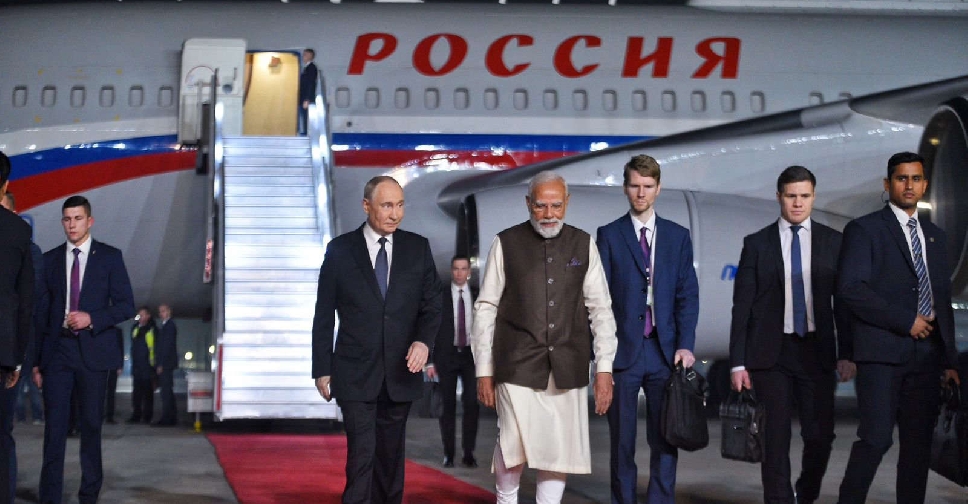
Russian President Vladimir Putin arrived in New Delhi on Thursday to start a two-day state visit, and India and Russia both said they want to boost mutual trade and expand the variety of items in transactions.
Putin's first visit to India in four years aims to increase sales of Russian oil, missile systems and fighter jets and broaden business links between the countries beyond energy and defence equipment, amid US pressure on India to move away from Moscow, which is waging war in Ukraine.
Indian Prime Minister Narendra Modi received Putin at the airport in Delhi, a rare gesture underlining the warm ties between the two countries and the leaders.
They embraced on the red carpet after Putin walked down from the aircraft and then drove away in the same vehicle.
Modi is hosting Putin for a private dinner on Thursday and the two will hold summit talks on Friday. Senior Russian ministers and a large Russian business delegation are in New Delhi for Putin's visit.
Delighted to welcome my friend, President Putin to India. Looking forward to our interactions later this evening and tomorrow. India-Russia friendship is a time tested one that has greatly benefitted our people.@KremlinRussia_E pic.twitter.com/L7IORzRfV9
— Narendra Modi (@narendramodi) December 4, 2025
INDIA SEEKS NEW MARKETS AFTER TRUMP TARIFFS
India and Russia aim to raise two-way trade to $100 billion by 2030. Their commerce rose more than five-fold from about $13 billion in 2021 to near $69 billion in 2024–25, almost entirely driven by Indian energy imports.
Bilateral trade eased to $28.25 billion in April–August 2025, reflecting a decline in crude oil imports following punitive tariffs on Indian goods and sanctions imposed by US President Donald Trump's administration.
At the same time, India is looking for new destinations to increase exports of its goods hit by a punishing 50 per cent tariff imposed by Trump, half of that over India buying Russian oil, which Washington says helps finance Moscow's war in Ukraine.
Russia wants to import more Indian goods to balance bilateral trade, which is currently heavily skewed towards energy, Deputy Kremlin Chief of Staff Maxim Oreshkin told a business conference in New Delhi.
"The Russian delegation and business representatives have arrived with a very specific goal ... We have come for Indian goods and services. We want to significantly increase their purchases," Oreshkin said.
"This is not a momentary story, but a strategic choice in developing relations" between the two countries, he said, adding that India's share in Russian imports does not exceed 2%.
DEMAND FOR INDIAN SHRIMP
Indian Trade Minister Piyush Goyal said New Delhi wants to diversify exports to Russia and increase sales of automobiles, electronics goods, data-processing equipment, heavy machinery, industrial components, textiles and foodstuffs.
“Russia has a huge demand for a wide range of industrial goods, consumer products, presenting multiple untapped opportunities for Indian businesses," Goyal told the conference.
"We need to bring more diversity in our trade basket. We need to make it more balanced between Russia and India. We need to add more variety," he said.
Russian Agriculture Minister Oksana Lut said Russia was prepared to increase imports of shrimp, rice and tropical fruits from India. She mentioned that Russian firms were also interested in Indian food-processing equipment.
India is the world's largest exporter of shrimp, and Lut noted that it was possible to increase India's share in Russian imports of shrimp, currently at 20 per cent.
India was the biggest supplier of shrimp to the US but Trump's tariffs have badly hit exports, causing a decline in shipments and forcing companies to seek alternative markets.

 Hezbollah warns Israeli residents to evacuate towns near border
 US House rejects war powers resolution, backs Trump on Iran war
 Saudi Arabia, Qatar, Kuwait intercept drones targeting territory
 GCC and EU ministers urge immediate halt to Iranian attacks
 India's tech state Karnataka bans social media for children under 16