

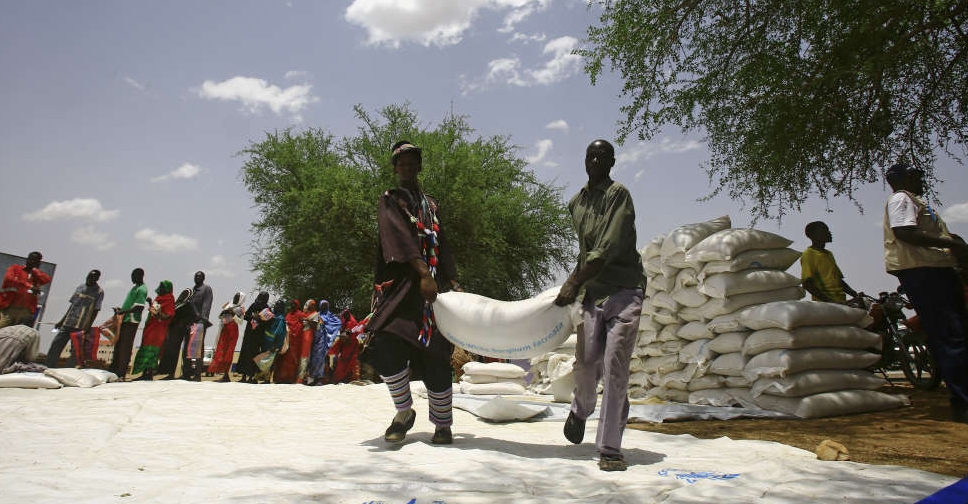
The Sudanese army said it broke a years-long siege on the city of Kadugli on Tuesday, potentially providing tens of thousands of people a reprieve from famine and signalling a shift in the war's momentum.
The conflict between the Sudanese army and the Rapid Support Forces (RSF) has displaced millions, drawn in regional powers and caused a vast humanitarian crisis since it broke out in April 2023.
Its latest frontline is the greater Kordofan region, which the RSF began sweeping through after the rainy season ended late last year.
"With God's help and guidance, your Sudanese Armed Forces and supporting forces have succeeded in opening the Kadugli-Dalanj road, after a heroic battle," the army said in a statement.
The RSF did not immediately respond to a request for comment.
Kadugli and nearby al-Dalanj had been under siege on and off since the start of the war. There was an escalation in fighting after the SPLM-N, which controls territory in the state and elsewhere, joined forces with the RSF last year.
The army broke the siege of al-Dalanj last week.
'MASSIVE, UNCHECKED SUFFERING'
In Kadugli the siege caused famine conditions confirmed by a global hunger monitor last year, and in both cities civilians were subjected to devastating drone attacks that have continued since the sieges were broken, residents said.
Jan Egeland, head of Norwegian Refugee Council, said he witnessed "massive, unchecked suffering" among those who fled Kadugli to camps in SPLM-N territory.
"The mothers had one recurrent story," he said in an interview with Reuters on Tuesday. "The drones are hitting their homes that are torched, and the people flee for their lives after having been starved for months," Egeland said.
People fleeing the siege of al-Fashir, which fell to the RSF in October, gave similar accounts.
Few aid agencies remain active in Kadugli or elsewhere in South Kordofan. The siege has driven up prices, according to local aid workers, with a kilo of flour reaching 80,000 Sudanese pounds (about $22).
That has put food out of reach for many, forcing them to eat leaves, while medicine and doctors are scarce, the aid workers said.
According to the United Nations, more than 80 per cent of Kadugli's population, or some 147,000 people, have fled.
ADVANCE ENABLED BY DRONES
The army's advance was aided by a breakdown in the RSF's supply lines from Libya into the Kordofan region, an army source and an SPLM-N source told Reuters.
Reuters reported on Monday that Egypt had deployed drones at an airstrip near its borders with Sudan and Libya, in what experts and officials said was a sign of its deepening involvement in Sudan. Libya's Kufrah airport, a major conduit for RSF supplies, announced on January 16 it would close for one month for renovations, though airport officials denied this was linked to Sudan's war.
Egypt has not acknowledged supporting the army militarily, but has said its national security is directly linked to Sudan's.
The army's advance was largely enabled by drone attacks and by allied armed groups recently recruited from local Nuba tribes, both sources said.
Egeland said that shifts in the war's frontlines had not alleviated civilian suffering, while efforts at a settlement, led by the United States, had failed.
"The peace diplomacy has failed to prevent that armed men, ruthless men, do whatever they want with the civilian population that they first starve and then attack," he said.

 WHO says first five patients evacuated via Gaza's Rafah crossing
 Russia pounds Ukraine with record number of missiles, Zelenskyy says
 Paris prosecutor's cybercrime unit searches X office
 Spain to ban social media access for children under 16
 Clintons agree to testify in Epstein congressional probe ahead of contempt vote