
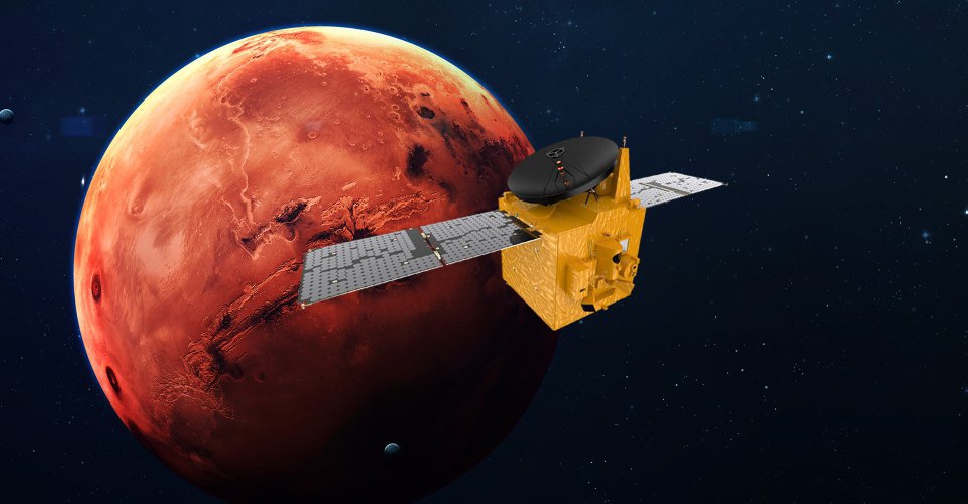
The UAE’s Hope probe has discovered a new type of proton aurora around Mars.
Aurorae are ultraviolet lights that appear on the planet when solar activity disturbs the atmosphere.
The ‘patchy’ proton aurora potentially triggers new insights into unexpected behaviours in the Martian atmosphere.
The Emirates Mars Mission team has worked together with NASA’s MAVEN (Mars Atmosphere and Volatile Evolution) mission to fully characterise these observations.
The Emirates Mar Mission (Hope Probe) has made first observations of a new type of proton aurora near Mars. The 'patchy' proton aurora could provide new insights into unexpected behaviors in the Martian atmosphere. pic.twitter.com/JmWRHpoHQc
— Hope Mars Mission (@HopeMarsMission) August 31, 2022
"Our discovery of this patchy proton aurora adds a new kind of event to the long list of those currently studied by EMM and challenges our existing views of how the proton aurora on Mars’ dayside are formed," said Hessa Al Matroushi, EMM’s Science Lead.
"The EMM Hope probe has so far uncovered many unexpected phenomena that extend our understanding of Mars’ atmospheric and magnetospheric dynamics. These new observations, combined with MAVEN data, have lifted the lid on entirely new possibilities for scientific research."
This new patchy type of proton aurora is formed when the solar wind directly impacts Mars’ dayside upper atmosphere and emits ultraviolet light as it slows down.
It was discovered in snapshots of the dayside disk obtained by the Emirates Mars Ultraviolet Spectrometer (EMUS), which observes the planet’s upper atmosphere and exosphere, scanning for variability in atmospheric composition and atmospheric escape to space.
The aurora manifests as bright regions scattered across the dayside of the planet in two ultraviolet wavelengths associated with the Hydrogen atom, Lyman beta at 102.6 nm and Lyman alpha at 121.6 nm. Under normal conditions, the dayside disk of the planet at these wavelengths is uniform, and the planetary brightness results from Hydrogen atoms scattering sunlight. When the aurora occurs, small regions of the planet become much brighter at these wavelengths, signifying intense localised energy deposition in the atmosphere.


 UAE President posts special message on Lunar New Year
 New UAE, Bahrain fast-track travel system takes off
 Dubai adjusts paid parking, Salik hours for Ramadan
 Dubai's Al Jalila Foundation unveils cancer support fund
 Dubai Police crowned champions of UAE Rescue Challenge
 UAE discusses strengthening partnership with NATO
 Dubai Police urge vigilance against online begging
 H.H. Sheikh Hamdan pays tribute to UAE's royal photographer
 Sharjah approves over AED76 million in debt settlement for citizens
 H.H. Sheikh Hamdan awards Arab Hope Makers
 UAE looks into framework to regulate children's social media use
 UAE Ramadan moon-sighting committee to meet on Tuesday
 RTA opens second bridge at Al Qudra intersection
 Abu Dhabi identifies over 40 modern heritage sites
 Distribution of aid from UAE's Saqr Humanitarian Ship begins in Gaza
 Dubai to expand bus and taxi lanes as public transport ridership grows by 7.4%
 Emir of Qatar welcomed by UAE President on visit to Abu Dhabi
 UAE, Egypt Foreign Ministers discuss Gaza peace plan
 UAE, Pakistan leaders discuss boosting economic ties
 UAE, Bosnia FMs discuss strengthening bilateral relations

