

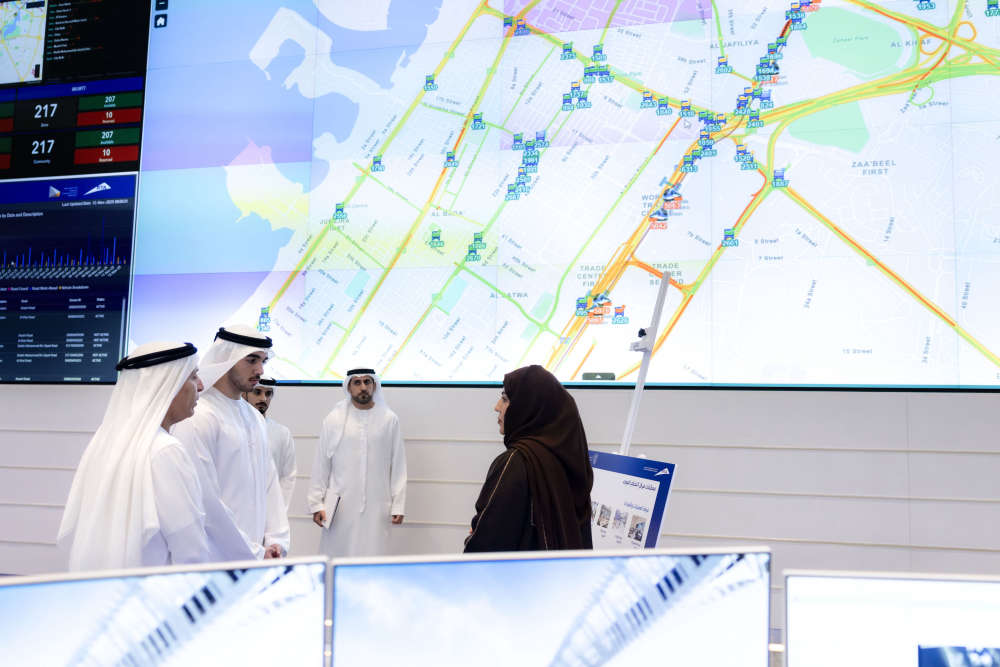
Sheikh Mohammed bin Rashid bin Mohammed has reviewed the strategic plan of Dubai’s Roads and Transport Authority (RTA) and its future projects aimed at enhancing the road network and public transport systems.
He also inspected RTA’s Enterprise Command and Control Centre (EC³), one of the world’s largest and most advanced facilities leveraging smart technologies. The centre oversees and manages traffic and transport operations, as well as incidents, emergencies, and crises.
RTA is the first government entity in the Middle East to operate all modes of transport from a single integrated facility.
Upon his arrival at the EC³, he was received by Mattar Al Tayer, Director-General, Chairman of the Board of Executive Directors of RTA. Sheikh Mohammed toured the facility, which oversees the management, control, and integration of all current and future modes of transport.
The centre supports effective mobility planning to address various transport needs and challenges across the emirate. It plays a key role in coordinating mobility during major events and exhibitions in Dubai, supporting centralised decision-making across all transport modes, managing emergencies and crises, enhancing the efficiency of bus operations, and assisting in taxi fleet planning.
The centre monitors and manages the movement of more than 28,000 transport vehicles and records and analyses 4.4 billion mobility data entries daily. It is connected to more than 10,000 cameras covering most of Dubai’s road network and public transport systems.
The main control room is linked to over 34 technological systems that are integrated in real time. Artificial intelligence is utilised in managing incidents and crises, while the centre’s technology system features machine-learning capabilities that ensure faster response times and minimise human error.
Sheikh Mohammed was briefed by Al Tayer on RTA’s strategic plan and its vision to achieve The World Leader in Seamless and Sustainable Mobility. Al Tayer also highlighted RTA’s ongoing efforts to enhance the infrastructure of Dubai’s road network and public transport system.
The road network spans more than 25,000 lane-kilometres and includes over 1,050 bridges and tunnels for vehicles, in addition to 177 pedestrian bridges and tunnels.
The public transport system features a 100-kilometre metro and tram network with 64 stations, a fleet of more than 1,300 public buses, 13,000 taxis and limousines, and 210 marine transport modes. Collectively, these systems serve more than two million riders daily.
His Highness was also briefed on the Dubai Metro Blue Line project, which extends 30 kilometres and comprises 14 stations. The line will connect the Red and Green lines, serving key residential, developmental, and industrial areas expected to house around one million residents by 2040. It will provide a direct link between these areas and Dubai International Airport in just 20 minutes.
He was also briefed on the latest developments of the aerial taxi project, which RTA is undertaking in collaboration with Joby Aviation Inc. and Skyports Infrastructure. The programme for flight testing and operational trials is being developed in a systematic manner.
In June this year, Joby completed a series of crewed test flights of its electric vertical take-off and landing (eVTOL) aerial taxi in Margham. The tests validated the aircraft’s performance and efficiency under local environmental conditions, paving the way for the planned launch of passenger services in 2026.
His Highness was further updated on the autonomous taxi project, under which RTA has signed agreements with leading international companies specialising in autonomous mobility to begin trial operations in Dubai.
These trials will lead to the commercial launch of autonomous taxi services in Q1 2026.

 New UAE, Bahrain fast-track travel system takes off
 Dubai adjusts paid parking hours for Ramadan
 Dubai's Al Jalila Foundation unveils cancer support fund
 Dubai Police crowned champions of the UAE Rescue Challenge 2026
 UAE discusses strengthening partnership with NATO
 Dubai Police urge vigilance against online begging
 H.H. Sheikh Hamdan pays tribute to UAE's royal photographer
 Sharjah approves over AED76 million in debt settlement for citizens
 H.H. Sheikh Hamdan awards Arab Hope Makers
 UAE looks into framework to regulate children's social media use
 UAE Ramadan moon-sighting committee to meet on Tuesday
 RTA opens second bridge at Al Qudra intersection
 Abu Dhabi identifies over 40 modern heritage sites
 Distribution of aid from UAE's Saqr Humanitarian Ship begins in Gaza
 Dubai to expand bus and taxi lanes as public transport ridership grows by 7.4%
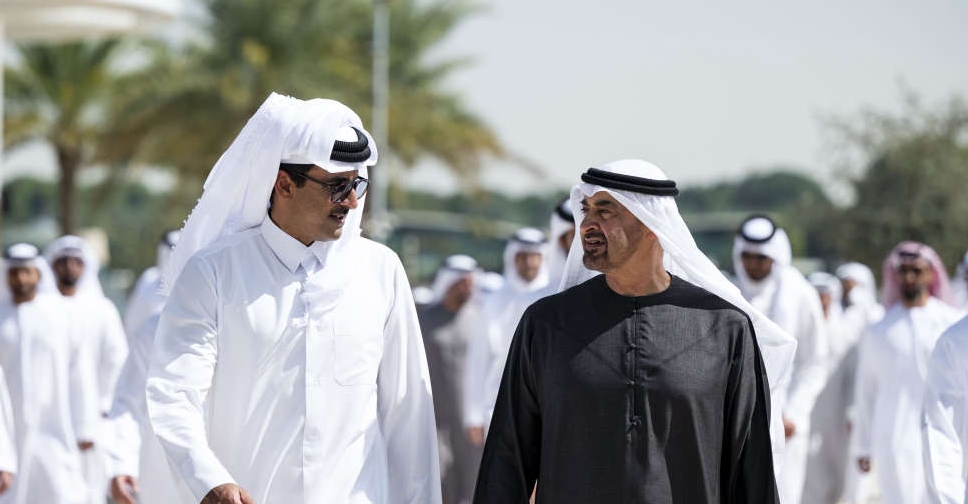 Emir of Qatar welcomed by UAE President on visit to Abu Dhabi
 UAE, Egypt Foreign Ministers discuss Gaza peace plan
 UAE, Pakistan leaders discuss boosting economic ties
 UAE, Bosnia FMs discuss strengthening bilateral relations
 H.H. Sheikh Mohammed launches campaign to rescue 5 million children from hunger

